
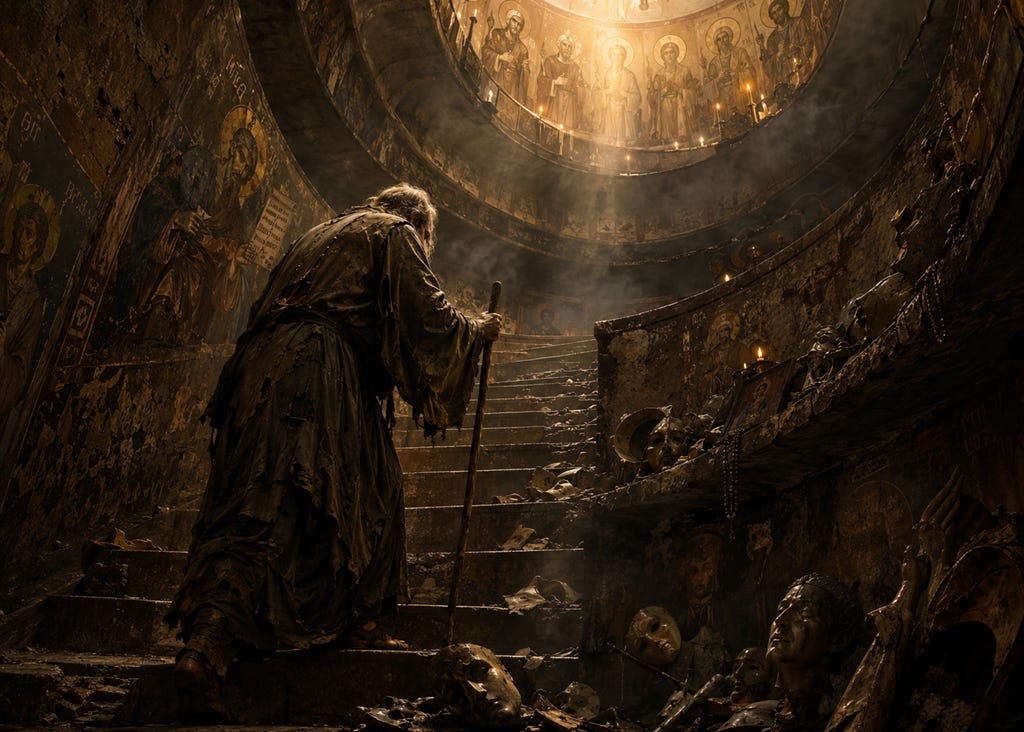
In the same way that those who use God’s name in vain to weaponise his name performatively in order to gain power and control through distortion and contortion may be viewed as blasphemous, so too can this apply to those who use God’s name as a conduit for sanctifying the worship of their own cowardice, avoidance, or discomfort. Conscience, discernment, will, and action matter, for faith is not complete outsourcing, nor is embodied existence binary, because we are his vessels, his participants - the way we weave ourselves into reality carries both his energetic signature and our own - theosis is meant to be the continual process of becoming more aligned with and transformed towards divine likeness through such participation.
If an individual repeatedly tells themselves, “God wanted this for me”, not from discernment but as a soothing mantra to avoid confronting that which they know in their soul is misaligned, then they are not truly honouring God, themselves, or the others whom they project onto. They are using the idea of God as a rhetorical force, a mechanism, or an excuse to justify reflexive responses, impulses, disavowed desires, and compulsions, or to soothe fear and sedate dissonance, desecrating ordainment in the process, for wielding spirituality in such a manner carries a certain arrogance and pride that shields the ego. The neurotic attribution of everything to divine will can become a refusal of agency itself, to the point that such behaviour becomes a disordered state in its own right, a self-perpetuating meta-layer of overzealous adherence that misses the gifts and opportunities of introspection, free will, intuition, humility, accountability, movement, courage, and moral participation that God has bestowed upon us to confront fear, grief, shame, doubt, discomfort, and the inherent felt uncertainty of certain authentic actions, for these things exist for a reason, wilful blindness does not erase them because life contains tensions and paradoxes to hold. Uncertainty, for example, creates space for humility to emerge. This is why repentance exists - it is inseparable from hope and faith that has been tested rather than just proclaimed, for true belief often settles only once one has endured, met, and confronted their own inversions. Saints are not revered because they were unblemished, but because they turned back to God with conviction and remained resolute despite their fallibility.
Faith is not meant to erase agency, but to refine and align it. Devotion and dependency need not collapse into binary opposites because surrender is not total erasure of the self, for genuine faith is meant to carry reverence, caution, and awareness of one’s own fallibility - thus, synergistic faith is a dynamic relational interplay, not a perfect blend confined to fixed ratios, as though divine will and human agency could be mathematically partitioned into one-dimensional static percentages. It is organically oscillatory - in some moments it feels as though one is carried, in others one must carry, yet both are present at all times. It is beautiful that even within this, there remains a sense of inevitability, grace, synchronicity, and orchestration beyond conscious control, for as apophatic theology imparts, there are undoubtedly limits to human comprehension, which is why we strive to continuously raise our consciousness, yet what we know with certainty is that we do not fully know - thus, humility and the willingness to remain open are part of the lesson itself because such openness requires synergistic faith.
Blasphemy carries an intentionality component, yet awareness itself exists along a fluid meta-level spectrum, encompassing blatant rebellious disregard or defiance, wilful self-deception, unconscious defence mechanisms, and genuine but immature discernment - thus, not all distortions are inherently blasphemous.
The Tenth Precept of my school of Buddhism is "a follower of the way does not abuse the three treasures" (the teachers, teachings, and the student community). This aligns in my mind with your admonishment to eschew performative Faith "as a soothing mantra to avoid confronting that which they know in their soul is misaligned...."
Thus, by either notion, it is de facto delusional to obscure reality behind notions of emptiness. The tenth precepts advises against using a teacher, teachings, or their identity in a community as the rationale for the retreat like you caution with "Faith is not meant to erase agency, but to refine and align it."
The essential ritual I practice, just sitting, is practiced without purpose. This is the devotional. There is no reason. I am a human being, not a human doing.
Thank you for sharing your thoughtful writing.